Close Modal
Download high-resolution image Look inside
Listen to a clip from the audiobook
audio pause button
0:00
0:00

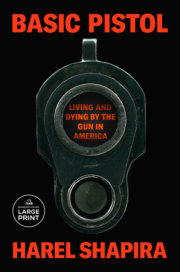
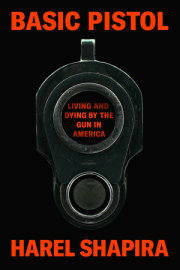
Basic Pistol

Living and Dying by the Gun in America

Look inside
Listen to a clip from the audiobook
audio pause button
0:00
0:00
Hardcover
$35.00 US
| $48.99 CAN
12 per carton
On sale Sep 15, 2026 | 320 Pages | 9780593317198

See Additional Formats
From an award-winning scholar of the political right comes an immersive and revelatory journey through the world of gun schools and the curriculum of fear they teach.

"Sobering."—New York Times Book Review

“At once page-turning and deeply disquieting, Harel Shapira’s Basic Pistol is a must read."—Heather Ann Thompson, author of Fear and Fury and the Pulitzer Prize-winning Blood in the Water


To understand why so many people die by the gun, we must first understand how so many people live by the gun.

This is the realization that led sociologist Harel Shapira to embed himself in Tactical Training, a popular firearms school in rural Texas. Here, students learn that any grocery store trip could become a shootout, and any day could be the day that a home intruder murders your family. They learn that waiting for the police to save the day is a death sentence. To be safe is to always carry a gun—and to always be ready and willing to use it.

Forty-two classes, ten thousand rounds of ammunition, and one concealed carry license later, Shapira has emerged with Basic Pistol, a dark and richly textured plunge into a uniquely American way of living. Basic Pistol follows Shapira’s fraught journey through the world of firearms schools and into a community for whom gun ownership is livelihood, is tradition, is identity. It exposes the racist fears and heroic fantasies gun owners are taught to carry alongside their guns. It shows how a relentless sense of vulnerability has empowered them to shoot with impunity. And it argues this education in violence, as much as any legislation, has torn through the social fabric, killing not only people but the very kinds of relationships that make democracy viable.

Page-turning and paradigm-shifting, Basic Pistol shows that if there’s any hope of reining in gun violence, it must start with the people who carry the guns.
1 A Philosophy of Living

I will never forget the first time I heard the sound of gunfire at Tactical Training. It was springtime, a few minutes before 9:00 a.m., and I had just arrived for my first class: Basic Pistol.

I had left my home in Austin around 7:00 a.m. to make the two-hour drive out. The closer I got to Tactical Training, the more rural my surroundings became. I drove through a metal gate, past a cattle guard, and down a rocky dirt path, then parked my car in an open field next to the ranch house, just as the detailed instructions sent out to students before class told me to. There was a split second of serenity as I got out of my car. And then a gunshot rang out.

It was just a single shot, and it came from a good hundred feet away. But it startled me. For a second, I was filled with terror. It was the kind I felt years back, when I was living in Chicago and shots would go off outside my home. My roommates and I would scurry to take cover. But this kind of gunshot was, of course, different.

I looked around, embarrassed that someone might have seen me flinch. The doors of a white SUV near me opened, and to my surprise two women came out of the car. They were white and looked to be in their mid- or late thirties. They were wearing trendy athleisure, the kind my wife wears when she goes to the gym.

Another gunshot, and again I flinched. But so did the women.

I would later learn that they too had driven out from Austin, and that they too were scared around guns. In fact, all six of the other students in that day's class-four of whom were women-were from Austin. Texas's liberal metropolis, thought of by many as a blue oasis in a red state, had rolled out on a spring morning to shoot some guns.

I made my way into the ranch house and saw Tom for the first time. He was wearing khaki shorts and a tucked-in beige T-shirt with the school's name stitched in blue letters right around the heart. In time, I would come to know this as his standard teaching outfit.

From the very first moment I met Tom, he always seemed like he was in a hurry. He talked fast and moved quickly, and he tossed out instructions to the other teachers on the fly. I walked up to him and introduced myself: I was the professor from the University of Texas who had emailed. I was anxious about his reaction, but there was hardly any at all. "Okay, great," he said. "Welcome, take a seat."

When Tom had first invited me to come take Basic Pistol, he'd made a point of telling me they "do not discuss politics or issues other than technical operation and safe handling of firearms during the course." His comment took me by surprise. I hadn't said anything about politics, and I wondered why he felt it necessary to set such a boundary. But I later realized he had assumed, not entirely without warrant, that I was a liberal and that I was critical of his world. I was also struck by his comment because of what it seemed to imply-that there are other courses where conversation is less circumscribed.

I sat down. On the table was a waiver for me to sign, indicating that I understood the risks of being in class. Next to the waiver was a red imitation gun made of a material that felt like squooshy rubber. And next to that was a twenty-page handout filled with text and pictures, covering everything from how to hold a gun to how to load one to how to shoot one to how to choose one. On the first page, in big, bold letters, it read, "Three Fundamental Rules of Gun Safety." This is how Basic Pistol began.

Rule 1: Always keep the muzzle pointed in a safe direction.

A "safe direction," Tom started lecturing, was a direction where you knew with certainty that if a bullet was fired, it would not hit anyone you did not intend to hit. "Do not aim your firearm at anything you are not ready to destroy," he added for emphasis.

I nodded along with the class, relieved to hear Tom speak with such gravity. He walked toward one of the walls. Would it be considered safe if you pointed your gun away from everyone and toward one of the walls in the room? he asked us. It seemed safe enough to me. There was no one in sight, and behind the wall was nothing but open sky. But I was wrong.

Could we see what was behind that wall? Did we understand that bullets can cause injury more than one mile away? That they can penetrate multiple walls? A safe direction, Tom explained, was a direction where you knew exactly where the bullet was going to go if it was fired. What if you pointed your gun down to the ground? Tom then asked. Are you on the second floor of a building? If the floor is concrete, could it potentially cause ricochet? Just as we needed to consider what lay beyond us, we needed to be cognizant of what lay below. We could never take too many precautions. Tom even suggested we keep a bucket filled with sand in our homes to point our guns toward when we want to clean them, in case of an accidental discharge.
Next came Rule 2: Always keep your finger off the trigger.

Tom said we must treat every gun as if it was loaded. It didn't matter if the gun didn't have a magazine in it, or if the gun's safety was on, or if the person handing you the gun swore on their life that it was unloaded. If you are holding a gun, Tom said, you treat it as if there's a live round in the chamber.

Tom then picked up an imitation gun to demonstrate. He turned his body toward us and showed us how to curl our hand around the grip while straightening our thumb up the back of the gun, extending our index finger-our trigger finger-across the side of the frame. He asked us to pick up the imitation guns at our tables and practice.

Tom walked around inspecting our grips. A second instructor, a young white man with unkempt hair who looked to be in his thirties, and who had been standing against the wall until now, did the same. One by one, they either approved or corrected our form.

I jotted down everything Tom was teaching, and I repeated it all in my head: Always keep your gun pointed in a safe direction, always treat every gun as if it is loaded, always keep your finger off the trigger. I was starting to feel more at ease. But then class continued, and Tom skipped clean over Rule 3: Always keep the gun unloaded until ready to use.

At first, I thought it might have been a simple oversight. But as I quickly learned, Tom Krone does nothing by accident, and certainly not with guns. Tom is careful, methodical, and intentional. He adamantly believes you should always keep your gun loaded and a round "chambered," meaning ready to fire. You can never predict when you may need to use it, Tom told us. So, before you holster your gun, you should load your magazine and rack your slide. "Loaded means loaded," he admonished us. "If you are going to be ready, be ready. There is no half-assing safety."

I would later learn that Rule 3 was popularized by the NRA in the 1980s, and it's a relic of handgun safety courses from the time. Although it is still embraced by many people today, it's a callback to an era when American gun culture was largely organized around sport and hunting, not self-defense. Tom thinks it's an idiotic idea. He believes that keeping a gun unloaded doesn't ensure safety. Quite the opposite, in fact. It ensures a too-slow reaction if the need ever comes to fire a shot. Safety, we were taught, is to keep your gun loaded with a round chambered, and to carry it wherever you go. "It's better to have it and not need it than not have it and need it," Tom said.

As a matter of preference, Tom also doesn't believe in carrying a gun with a safety, which prevents the gun from firing. Releasing a safety takes time, a split second perhaps. And as Tom explained, "When it comes to your life, every second counts." This phrase is a favorite of Tom's. I would come to hear it many, many more times in my years as his student. Moreover, Tom continued, having a safety is superfluous because we should know to always keep our finger off the trigger until we are ready to shoot. "You are the safety," he told us. On that first day, Tom tempered his comment. "Obviously, it's better to have a gun with a safety than no gun at all," he said. Whatever gun we had, the most important thing was not the gun itself but the skill and preparation of its carrier.

Throughout the class, I heard the words "preparation" and "training" time and again. But I didn't quite understand what it was that Tom was preparing and training us for. It didn't click for me until one of the women in the class asked Tom about the safest way to store a gun.

In response to her question, Tom called up one of his fellow instructors and asked him to play the "bad guy" opposite Tom, the "good guy." In the scenario that unfolded, Tom was at home. The bad guy broke in, and Tom scrambled to retrieve his gun. He pretended his gun was stored in a lockbox that required a key to open, and he struggled to fit the key in and turn it. Meanwhile, the other instructor pulled out one of the red rubber imitation guns. He yelled out, "Bang! Bang! You are dead!" Tom fell limp to the ground.

Then they rewound the scenario. "Now watch what happens," Tom said as they took their places. I could hear the excitement in his voice.

Just as before, the "bad guy" entered the home, and Tom went to get his gun. Only this time, the gun wasn't locked up in a safe. It was holstered at his side. Tom drew the gun, turned, and fired a few shots. "Bang! Bang!" he yelled. "You're dead."

The scenario startled me. Tom's suggestion that we could, and in fact would, die if we kept our guns locked up felt extreme. And frankly, I just didn't buy it. Moreover, the shift from learning how to hold a gun to learning not to lock one up lest I be killed came suddenly and unexpectedly. I didn't feel prepared, technically or emotionally, to start thinking about killing and being killed.

As class went on, a pattern emerged. Each technical lesson was paired with a life-or-death scenario, a cognitive lesson about how to perceive and respond to danger. When Tom taught us about the difference between .22-, .38-, 9 mm, .40-, and .45-caliber ammo, he drew a bullet on the board and explained that these numbers referenced the diameter of the bullet. This technical knowledge, however, was just the foundation for the key takeaway: that a .22 simply does not have enough "stopping power" to "defeat a bad guy."

When he talked to us about gun magazines-the rectangular receptacles that hold ammunition and attach to the bottom of a gun-Tom began with a technical demonstration of how to hold them and slot them in. As before, the technical demonstration shifted to one about safety and danger. When it came to choosing a gun, we were meant to maximize both firepower and magazine capacity. Tom said we should aim to carry a gun with thirteen to seventeen rounds. He told us about a police officer who needed to shoot a perpetrator twenty-two times with a high-caliber Glock 40 before the "bad guy" finally stopped attacking.

These kinds of stories are based on real events. Tom is never lying when he recounts them to us. But when I later researched his story of that police officer, I also found several others that Tom never mentioned in class, stories of people who had stopped attacking after being shot once-and not in the head or chest, but in the arm or leg, and not with a large-caliber .40 but with a smaller-caliber .22. Tom is aware of these stories, too. He even acknowledges that "most bad guys will stop fighting even after one shot." But at Tactical Training, I learned quickly that we do not train for those kinds of scenarios. We train for the worst-case scenarios.

Tom wrapped up the first part of the class by teaching us about the difference between "cover" and "concealment." He explained that while concealment means that a person is not visible to a "bad guy," cover means that a person is protected from the bullets fired by the "bad guy." Tom quizzed us: Would standing behind a wall be an example of concealment or cover?

I thought back to earlier in the Basic Pistol class, when Tom taught us that pointing a gun toward a wall would not be considered pointing a gun in a "safe direction," because bullets can penetrate multiple walls. I rightly anticipated that the answer was no, a wall does not offer cover. Tom then asked us whether squatting behind a car during a gunfight would be concealment or cover. I thought about all the movies I had watched where people kneel behind a car when being shot at, and so I assumed a car does provide cover. But like many others in the class, I was wrong. Tom pointed out that there is only one part of the car that a bullet cannot penetrate: the engine block. This was far from a piece of trivial academic knowledge to Tom. It was nothing less than lifesaving information: "So get behind that engine block!"

Class had come full circle from where it began. At the start, Tom taught us about how to be safe with our guns: Treat every gun as if it's loaded, keep your finger off the trigger, bullets can penetrate walls, don't point a gun at anything unless you intend to destroy it. As class moved on, I began to realize we weren't primarily learning how to use a gun safely. We were learning how to use a gun to stay safe-from the home intruder, from the shooter in the parking lot, from the "bad guy" out to hurt us and our families.

About an hour and a half into class, we moved outside to the firing line. For the first time in nearly a decade, and for only the second time in my life, I was going to shoot a gun. I was nervous, but less so than when class began. Before we fired a single round, Tom covered the basic technical aspects of how to shoot. He demonstrated how to take a proper stance ("nose over toes"), how to aim ("front sight should be centered between rear sights"), the proper ready position ("both hands on gun, arms bent toward chest, gun forward and tilted slightly downward"), how to press the trigger ("smooth, don't slap it"), and proper follow-through ("keep your gun focused on the target").
"At once page-turning and deeply disquieting, Harel Shapira’s Basic Pistol is a must read for anyone who wants to understand not just why gun violence is so devastatingly prevalent in the United States, but also, and as importantly, how gun ownership has become so normalized, so passionately defended, and so much a part of how countless people now measure their sense of safety as well as connect to their community."—Heather Ann Thompson, author of Fear and Fury and the Pulitzer Prize-winning Blood in the Water

“Sobering . . . . [Basic Pistol] clearly depicts how firearm training centers assiduously cultivate a hair-trigger sensibility. The good guy with a gun is made, not born, and he is made through fear . . . . [It] suggests a deeper tragedy wrought on the relationships of trust and mutuality that make American democracy possible in the first place.”—Texas Observer

"Basic Pistol is masterfully crafted. It penetrates the heart of American gun culture and, somehow, renders it both deeply human and utterly monstrous. It’s a fascinating, disturbing, and necessary book about the violence of everyday life in the United States."—Eric Klinenberg, Helen Gould Shepard Professor in the Social Sciences, New York University

"Utterly brilliant. So much more than the usual diatribe about guns: it is deeply researched and thoughtful. It tells a story about a culture without inviting us to dislike any of the people involved."—Justin Webb, former BBC North America editor

"With analytic rigor, literary skill, and a deep understanding of his subjects, Harel Shapira takes us into the culture of gun ownership and the far-right with a skill that surpasses most journalism on the subject. Basic Pistol memorably demonstrates how a gun safety training program can amount to indoctrination into a never-ending, trigger-ready state of high alert."—Nicholas Lemann, Pulitzer-Moore Professor and Dean Emeritus, Columbia Journalism School, and author of Transaction Man

"Basic Pistol is groundbreaking ethnography. In this fascinating deep dive into America’s obsession with guns, Harel Shapira shows how this culture of violence and doom permeates our communities and shapes our politics.”—Adam Winkler, Connell Professor of Law, UCLA, and author of We the Corporations and Gunfight.

"Unqiuely researched . . . . an important addition to the conversation about gun violence in the United States."—Library Journal

"Chilling . . . . An eye-opening study that makes its own case for stricter gun control."—Kirkus Reviews

"A vivid and unique perspective on U.S. gun culture."—Publishers Weekly
© Jamie Kovach
Harel Shapira is an associate professor in the Department of Sociology at the University of Texas at Austin. He received his BA from the University of Chicago and his PhD from Columbia University. Shapira uses long- term ethnographic research to understand right- wing politics and gun culture in contemporary America. He is the author of Waiting for José: The Minutemen’s Pursuit of America (Princeton University Press, 2013) and the coeditor of Gun Studies: Interdisciplinary Approaches to Politics, Policy, and Practice (Oxford University Press, 2019, with Jennifer Carlson and Kristin Goss). His research has been funded by the National Science Foundation as well as the Harry Frank Guggenheim Foundation, and his writing has been featured in numerous outlets, including The New York Times and The New Republic. He was named an Andrew Carnegie Fellow in 2015 and a Member of the Institute for Advanced Study in 2021. View titles by Harel Shapira

About

From an award-winning scholar of the political right comes an immersive and revelatory journey through the world of gun schools and the curriculum of fear they teach.

"Sobering."—New York Times Book Review

“At once page-turning and deeply disquieting, Harel Shapira’s Basic Pistol is a must read."—Heather Ann Thompson, author of Fear and Fury and the Pulitzer Prize-winning Blood in the Water


To understand why so many people die by the gun, we must first understand how so many people live by the gun.

This is the realization that led sociologist Harel Shapira to embed himself in Tactical Training, a popular firearms school in rural Texas. Here, students learn that any grocery store trip could become a shootout, and any day could be the day that a home intruder murders your family. They learn that waiting for the police to save the day is a death sentence. To be safe is to always carry a gun—and to always be ready and willing to use it.

Forty-two classes, ten thousand rounds of ammunition, and one concealed carry license later, Shapira has emerged with Basic Pistol, a dark and richly textured plunge into a uniquely American way of living. Basic Pistol follows Shapira’s fraught journey through the world of firearms schools and into a community for whom gun ownership is livelihood, is tradition, is identity. It exposes the racist fears and heroic fantasies gun owners are taught to carry alongside their guns. It shows how a relentless sense of vulnerability has empowered them to shoot with impunity. And it argues this education in violence, as much as any legislation, has torn through the social fabric, killing not only people but the very kinds of relationships that make democracy viable.

Page-turning and paradigm-shifting, Basic Pistol shows that if there’s any hope of reining in gun violence, it must start with the people who carry the guns.

Excerpt

1 A Philosophy of Living

I will never forget the first time I heard the sound of gunfire at Tactical Training. It was springtime, a few minutes before 9:00 a.m., and I had just arrived for my first class: Basic Pistol.

I had left my home in Austin around 7:00 a.m. to make the two-hour drive out. The closer I got to Tactical Training, the more rural my surroundings became. I drove through a metal gate, past a cattle guard, and down a rocky dirt path, then parked my car in an open field next to the ranch house, just as the detailed instructions sent out to students before class told me to. There was a split second of serenity as I got out of my car. And then a gunshot rang out.

It was just a single shot, and it came from a good hundred feet away. But it startled me. For a second, I was filled with terror. It was the kind I felt years back, when I was living in Chicago and shots would go off outside my home. My roommates and I would scurry to take cover. But this kind of gunshot was, of course, different.

I looked around, embarrassed that someone might have seen me flinch. The doors of a white SUV near me opened, and to my surprise two women came out of the car. They were white and looked to be in their mid- or late thirties. They were wearing trendy athleisure, the kind my wife wears when she goes to the gym.

Another gunshot, and again I flinched. But so did the women.

I would later learn that they too had driven out from Austin, and that they too were scared around guns. In fact, all six of the other students in that day's class-four of whom were women-were from Austin. Texas's liberal metropolis, thought of by many as a blue oasis in a red state, had rolled out on a spring morning to shoot some guns.

I made my way into the ranch house and saw Tom for the first time. He was wearing khaki shorts and a tucked-in beige T-shirt with the school's name stitched in blue letters right around the heart. In time, I would come to know this as his standard teaching outfit.

From the very first moment I met Tom, he always seemed like he was in a hurry. He talked fast and moved quickly, and he tossed out instructions to the other teachers on the fly. I walked up to him and introduced myself: I was the professor from the University of Texas who had emailed. I was anxious about his reaction, but there was hardly any at all. "Okay, great," he said. "Welcome, take a seat."

When Tom had first invited me to come take Basic Pistol, he'd made a point of telling me they "do not discuss politics or issues other than technical operation and safe handling of firearms during the course." His comment took me by surprise. I hadn't said anything about politics, and I wondered why he felt it necessary to set such a boundary. But I later realized he had assumed, not entirely without warrant, that I was a liberal and that I was critical of his world. I was also struck by his comment because of what it seemed to imply-that there are other courses where conversation is less circumscribed.

I sat down. On the table was a waiver for me to sign, indicating that I understood the risks of being in class. Next to the waiver was a red imitation gun made of a material that felt like squooshy rubber. And next to that was a twenty-page handout filled with text and pictures, covering everything from how to hold a gun to how to load one to how to shoot one to how to choose one. On the first page, in big, bold letters, it read, "Three Fundamental Rules of Gun Safety." This is how Basic Pistol began.

Rule 1: Always keep the muzzle pointed in a safe direction.

A "safe direction," Tom started lecturing, was a direction where you knew with certainty that if a bullet was fired, it would not hit anyone you did not intend to hit. "Do not aim your firearm at anything you are not ready to destroy," he added for emphasis.

I nodded along with the class, relieved to hear Tom speak with such gravity. He walked toward one of the walls. Would it be considered safe if you pointed your gun away from everyone and toward one of the walls in the room? he asked us. It seemed safe enough to me. There was no one in sight, and behind the wall was nothing but open sky. But I was wrong.

Could we see what was behind that wall? Did we understand that bullets can cause injury more than one mile away? That they can penetrate multiple walls? A safe direction, Tom explained, was a direction where you knew exactly where the bullet was going to go if it was fired. What if you pointed your gun down to the ground? Tom then asked. Are you on the second floor of a building? If the floor is concrete, could it potentially cause ricochet? Just as we needed to consider what lay beyond us, we needed to be cognizant of what lay below. We could never take too many precautions. Tom even suggested we keep a bucket filled with sand in our homes to point our guns toward when we want to clean them, in case of an accidental discharge.
Next came Rule 2: Always keep your finger off the trigger.

Tom said we must treat every gun as if it was loaded. It didn't matter if the gun didn't have a magazine in it, or if the gun's safety was on, or if the person handing you the gun swore on their life that it was unloaded. If you are holding a gun, Tom said, you treat it as if there's a live round in the chamber.

Tom then picked up an imitation gun to demonstrate. He turned his body toward us and showed us how to curl our hand around the grip while straightening our thumb up the back of the gun, extending our index finger-our trigger finger-across the side of the frame. He asked us to pick up the imitation guns at our tables and practice.

Tom walked around inspecting our grips. A second instructor, a young white man with unkempt hair who looked to be in his thirties, and who had been standing against the wall until now, did the same. One by one, they either approved or corrected our form.

I jotted down everything Tom was teaching, and I repeated it all in my head: Always keep your gun pointed in a safe direction, always treat every gun as if it is loaded, always keep your finger off the trigger. I was starting to feel more at ease. But then class continued, and Tom skipped clean over Rule 3: Always keep the gun unloaded until ready to use.

At first, I thought it might have been a simple oversight. But as I quickly learned, Tom Krone does nothing by accident, and certainly not with guns. Tom is careful, methodical, and intentional. He adamantly believes you should always keep your gun loaded and a round "chambered," meaning ready to fire. You can never predict when you may need to use it, Tom told us. So, before you holster your gun, you should load your magazine and rack your slide. "Loaded means loaded," he admonished us. "If you are going to be ready, be ready. There is no half-assing safety."

I would later learn that Rule 3 was popularized by the NRA in the 1980s, and it's a relic of handgun safety courses from the time. Although it is still embraced by many people today, it's a callback to an era when American gun culture was largely organized around sport and hunting, not self-defense. Tom thinks it's an idiotic idea. He believes that keeping a gun unloaded doesn't ensure safety. Quite the opposite, in fact. It ensures a too-slow reaction if the need ever comes to fire a shot. Safety, we were taught, is to keep your gun loaded with a round chambered, and to carry it wherever you go. "It's better to have it and not need it than not have it and need it," Tom said.

As a matter of preference, Tom also doesn't believe in carrying a gun with a safety, which prevents the gun from firing. Releasing a safety takes time, a split second perhaps. And as Tom explained, "When it comes to your life, every second counts." This phrase is a favorite of Tom's. I would come to hear it many, many more times in my years as his student. Moreover, Tom continued, having a safety is superfluous because we should know to always keep our finger off the trigger until we are ready to shoot. "You are the safety," he told us. On that first day, Tom tempered his comment. "Obviously, it's better to have a gun with a safety than no gun at all," he said. Whatever gun we had, the most important thing was not the gun itself but the skill and preparation of its carrier.

Throughout the class, I heard the words "preparation" and "training" time and again. But I didn't quite understand what it was that Tom was preparing and training us for. It didn't click for me until one of the women in the class asked Tom about the safest way to store a gun.

In response to her question, Tom called up one of his fellow instructors and asked him to play the "bad guy" opposite Tom, the "good guy." In the scenario that unfolded, Tom was at home. The bad guy broke in, and Tom scrambled to retrieve his gun. He pretended his gun was stored in a lockbox that required a key to open, and he struggled to fit the key in and turn it. Meanwhile, the other instructor pulled out one of the red rubber imitation guns. He yelled out, "Bang! Bang! You are dead!" Tom fell limp to the ground.

Then they rewound the scenario. "Now watch what happens," Tom said as they took their places. I could hear the excitement in his voice.

Just as before, the "bad guy" entered the home, and Tom went to get his gun. Only this time, the gun wasn't locked up in a safe. It was holstered at his side. Tom drew the gun, turned, and fired a few shots. "Bang! Bang!" he yelled. "You're dead."

The scenario startled me. Tom's suggestion that we could, and in fact would, die if we kept our guns locked up felt extreme. And frankly, I just didn't buy it. Moreover, the shift from learning how to hold a gun to learning not to lock one up lest I be killed came suddenly and unexpectedly. I didn't feel prepared, technically or emotionally, to start thinking about killing and being killed.

As class went on, a pattern emerged. Each technical lesson was paired with a life-or-death scenario, a cognitive lesson about how to perceive and respond to danger. When Tom taught us about the difference between .22-, .38-, 9 mm, .40-, and .45-caliber ammo, he drew a bullet on the board and explained that these numbers referenced the diameter of the bullet. This technical knowledge, however, was just the foundation for the key takeaway: that a .22 simply does not have enough "stopping power" to "defeat a bad guy."

When he talked to us about gun magazines-the rectangular receptacles that hold ammunition and attach to the bottom of a gun-Tom began with a technical demonstration of how to hold them and slot them in. As before, the technical demonstration shifted to one about safety and danger. When it came to choosing a gun, we were meant to maximize both firepower and magazine capacity. Tom said we should aim to carry a gun with thirteen to seventeen rounds. He told us about a police officer who needed to shoot a perpetrator twenty-two times with a high-caliber Glock 40 before the "bad guy" finally stopped attacking.

These kinds of stories are based on real events. Tom is never lying when he recounts them to us. But when I later researched his story of that police officer, I also found several others that Tom never mentioned in class, stories of people who had stopped attacking after being shot once-and not in the head or chest, but in the arm or leg, and not with a large-caliber .40 but with a smaller-caliber .22. Tom is aware of these stories, too. He even acknowledges that "most bad guys will stop fighting even after one shot." But at Tactical Training, I learned quickly that we do not train for those kinds of scenarios. We train for the worst-case scenarios.

Tom wrapped up the first part of the class by teaching us about the difference between "cover" and "concealment." He explained that while concealment means that a person is not visible to a "bad guy," cover means that a person is protected from the bullets fired by the "bad guy." Tom quizzed us: Would standing behind a wall be an example of concealment or cover?

I thought back to earlier in the Basic Pistol class, when Tom taught us that pointing a gun toward a wall would not be considered pointing a gun in a "safe direction," because bullets can penetrate multiple walls. I rightly anticipated that the answer was no, a wall does not offer cover. Tom then asked us whether squatting behind a car during a gunfight would be concealment or cover. I thought about all the movies I had watched where people kneel behind a car when being shot at, and so I assumed a car does provide cover. But like many others in the class, I was wrong. Tom pointed out that there is only one part of the car that a bullet cannot penetrate: the engine block. This was far from a piece of trivial academic knowledge to Tom. It was nothing less than lifesaving information: "So get behind that engine block!"

Class had come full circle from where it began. At the start, Tom taught us about how to be safe with our guns: Treat every gun as if it's loaded, keep your finger off the trigger, bullets can penetrate walls, don't point a gun at anything unless you intend to destroy it. As class moved on, I began to realize we weren't primarily learning how to use a gun safely. We were learning how to use a gun to stay safe-from the home intruder, from the shooter in the parking lot, from the "bad guy" out to hurt us and our families.

About an hour and a half into class, we moved outside to the firing line. For the first time in nearly a decade, and for only the second time in my life, I was going to shoot a gun. I was nervous, but less so than when class began. Before we fired a single round, Tom covered the basic technical aspects of how to shoot. He demonstrated how to take a proper stance ("nose over toes"), how to aim ("front sight should be centered between rear sights"), the proper ready position ("both hands on gun, arms bent toward chest, gun forward and tilted slightly downward"), how to press the trigger ("smooth, don't slap it"), and proper follow-through ("keep your gun focused on the target").

Reviews

"At once page-turning and deeply disquieting, Harel Shapira’s Basic Pistol is a must read for anyone who wants to understand not just why gun violence is so devastatingly prevalent in the United States, but also, and as importantly, how gun ownership has become so normalized, so passionately defended, and so much a part of how countless people now measure their sense of safety as well as connect to their community."—Heather Ann Thompson, author of Fear and Fury and the Pulitzer Prize-winning Blood in the Water

“Sobering . . . . [Basic Pistol] clearly depicts how firearm training centers assiduously cultivate a hair-trigger sensibility. The good guy with a gun is made, not born, and he is made through fear . . . . [It] suggests a deeper tragedy wrought on the relationships of trust and mutuality that make American democracy possible in the first place.”—Texas Observer

"Basic Pistol is masterfully crafted. It penetrates the heart of American gun culture and, somehow, renders it both deeply human and utterly monstrous. It’s a fascinating, disturbing, and necessary book about the violence of everyday life in the United States."—Eric Klinenberg, Helen Gould Shepard Professor in the Social Sciences, New York University

"Utterly brilliant. So much more than the usual diatribe about guns: it is deeply researched and thoughtful. It tells a story about a culture without inviting us to dislike any of the people involved."—Justin Webb, former BBC North America editor

"With analytic rigor, literary skill, and a deep understanding of his subjects, Harel Shapira takes us into the culture of gun ownership and the far-right with a skill that surpasses most journalism on the subject. Basic Pistol memorably demonstrates how a gun safety training program can amount to indoctrination into a never-ending, trigger-ready state of high alert."—Nicholas Lemann, Pulitzer-Moore Professor and Dean Emeritus, Columbia Journalism School, and author of Transaction Man

"Basic Pistol is groundbreaking ethnography. In this fascinating deep dive into America’s obsession with guns, Harel Shapira shows how this culture of violence and doom permeates our communities and shapes our politics.”—Adam Winkler, Connell Professor of Law, UCLA, and author of We the Corporations and Gunfight.

"Unqiuely researched . . . . an important addition to the conversation about gun violence in the United States."—Library Journal

"Chilling . . . . An eye-opening study that makes its own case for stricter gun control."—Kirkus Reviews

"A vivid and unique perspective on U.S. gun culture."—Publishers Weekly

Author

© Jamie Kovach
Harel Shapira is an associate professor in the Department of Sociology at the University of Texas at Austin. He received his BA from the University of Chicago and his PhD from Columbia University. Shapira uses long- term ethnographic research to understand right- wing politics and gun culture in contemporary America. He is the author of Waiting for José: The Minutemen’s Pursuit of America (Princeton University Press, 2013) and the coeditor of Gun Studies: Interdisciplinary Approaches to Politics, Policy, and Practice (Oxford University Press, 2019, with Jennifer Carlson and Kristin Goss). His research has been funded by the National Science Foundation as well as the Harry Frank Guggenheim Foundation, and his writing has been featured in numerous outlets, including The New York Times and The New Republic. He was named an Andrew Carnegie Fellow in 2015 and a Member of the Institute for Advanced Study in 2021. View titles by Harel Shapira
  • More Websites from
    Penguin Random House
  • Common Reads
  • Library Marketing