Close Modal

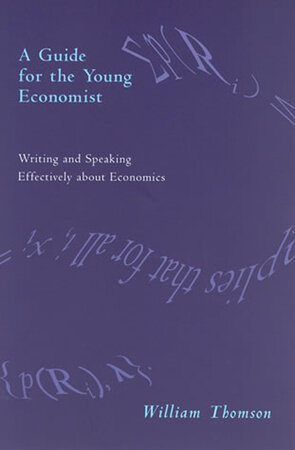
A Guide for the Young Economist

This book is an invaluable guide for young economists working on their dissertations, preparing their first articles for submission to professional journals, getting ready for their first presentations at conferences and job seminars, or facing their first refereeing assignments. In clear, concise language—a model for what he advocates—William Thomson shows how to make written and oral presentations both inviting and efficient. Thomson covers the basics of clear exposition, including such nuts-and-bolts topics as titling papers, writing abstracts, presenting research results, and holding an audience's attention.
This guide should be read by every young economist under the age of 90...The book is truly beautifully written...BUY THIS BOOK!—NBER Southern Economic Journal—

Thomson provides a solid, in-depth introduction to some of the most important aspects of writing and presenting economic reports and papers, which will be particularly valuable to graduate students, new faculty, and professionals wishing to present their research in a clear, effective manner.

—Choice—
William Thomson is Elmer B. Milliman Professor of Economics at the University of Rochester.
I Being a Graduate Student in Economics
1 Going through the program
2 Doing research
3 Your advisor
4 Job market 40
5 Dissertation defense
II Writing Papers
6 General principles
7 The components of your paper
8 Notation
9 Definitions
10 Naming things 125
11 Style 138
12 Models 148
13 Doing proofs and presenting them: General comments 156
14 Proofs: details of presentation
15 Figures 191
16 Finishing and revising
III Giving Talks
17 General principles
18 Dealing with us, your audience
19 Using the screen
20 If you write on the board
21 A little exercise about introductions
IV Writing Referee Reports
22 Your frst refereeing job
23 Your responsibility to the journal and the author

About

This book is an invaluable guide for young economists working on their dissertations, preparing their first articles for submission to professional journals, getting ready for their first presentations at conferences and job seminars, or facing their first refereeing assignments. In clear, concise language—a model for what he advocates—William Thomson shows how to make written and oral presentations both inviting and efficient. Thomson covers the basics of clear exposition, including such nuts-and-bolts topics as titling papers, writing abstracts, presenting research results, and holding an audience's attention.

Reviews

This guide should be read by every young economist under the age of 90...The book is truly beautifully written...BUY THIS BOOK!—NBER Southern Economic Journal—

Thomson provides a solid, in-depth introduction to some of the most important aspects of writing and presenting economic reports and papers, which will be particularly valuable to graduate students, new faculty, and professionals wishing to present their research in a clear, effective manner.

—Choice—
Author

William Thomson is Elmer B. Milliman Professor of Economics at the University of Rochester.

Table of Contents

I Being a Graduate Student in Economics
1 Going through the program
2 Doing research
3 Your advisor
4 Job market 40
5 Dissertation defense
II Writing Papers
6 General principles
7 The components of your paper
8 Notation
9 Definitions
10 Naming things 125
11 Style 138
12 Models 148
13 Doing proofs and presenting them: General comments 156
14 Proofs: details of presentation
15 Figures 191
16 Finishing and revising
III Giving Talks
17 General principles
18 Dealing with us, your audience
19 Using the screen
20 If you write on the board
21 A little exercise about introductions
IV Writing Referee Reports
22 Your frst refereeing job
23 Your responsibility to the journal and the author
  • More Websites from
    Penguin Random House
  • Common Reads
  • Library Marketing